Showing posts with label writing process. Show all posts

Thursday, February 21, 2013

The Crucible

...when he hath tried me, I shall come forth as gold.

Harry and Voldy, in the crucible of "the Prophecy"
I've been reading David Farland's e-book "Million Dollar Outlines" lately to review elements of story and the various tools useful to writing fiction.

One area he covers is the crucible; the element of the story that keeps your characters there/involved/together. The thing that answers the question about why they don't just leave or give up when the trouble starts.

In one of my writing projects, this element is a struggle, because the characters have to keep deciding to be involved each day, voluntarily, actively, and their involvement means that bad things keep happening to them. The reader is certainly going to ask: Why would they stay here?

In Dave's book, he uses the example of a man and woman in a bad marriage. Why don't they just get divorced? Marriage is a voluntary arrangement. Of course, we all would come up with his answer: the children. It is believable that they would try to work things out for the sake of the children.

So there must be reasons, good reasons, why our characters keep going, keep on keeping on, even in the face of trial and tribulation.

I did a brainstorming exercise once with Orson Scott Card where we all came up with a lot of answers to the "why?" question, and he kept twisting and turning the answers until we came up with less cliche outcomes. I think this is also important to do with our crucibles.

Maybe the married couple stay together for the children, that's easy. But let's twist that. Perhaps instead it is the stress from the children that is tearing the couple apart. Maybe the children even want the divorce, or say they do. So what then? We get to dig deeper and invent new reasons the couple must stay together. Maybe both husband and wife both had divorced parents and never wanted to become like their parents. Or maybe everyone told the wife she was making a mistake, that the marriage would never last, and she wants desperately to prove everyone wrong. Maybe the husband hates failure and so doesn't want to admit defeat. Maybe one or the other is in politics or business where the image of marriage is important. Whatever we choose, we must have a crucible or we have no story. We must thoroughly answer the reader questions about why our characters are going through the trouble instead of giving up or avoiding it. Otherwise, they just seem like dogged dolts.

So, what are some of your favorite crucibles, either in stories you've written or read?


Write on,
Amber M
http://www.mindsbase.com

Tuesday, September 4, 2012

Grabbing the bull by the horns


Overheard at my dinner table:
Dad: You just gotta grab the bull by the horns.
Son #2: And do a flip onto it, and ride it on home. (laughs)
Son #1: (shakes head) Little kids are so literal.

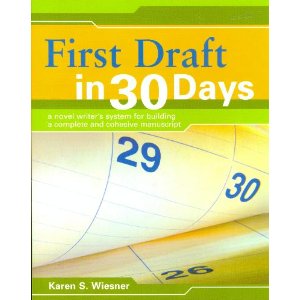
Well, maybe I'm literal too, but when I saw the book First Draft in 30 days by Karen Wiesner, I thought, "Who wouldn't want that?" and bought it from the title alone. The fact that my familiy was (very) ready to leave the bookstore may have been a factor, but either way, on that day I became the newest author to fall for a get-a-book-quick scheme. :)

Upon closer perusal of my new treasure, I discovered that Wiesner's method doesn't actually produce a manuscript in 30 days, but rather a detailed outline from which you can produce a fairly painless, solid, semi-final draft. Okay, that sounds more reasonable. And, more what I need anyway, because I haven't thought too much about outlines since my junior high school days. I did create an outline for my first novel (and the whole series) but that was a simple roman-numeral plot sequence outline. Since then, other than a little dabbling in the snowflake method, I have been acting as a seat-of-the-pants discovery writer even though I know it doesn't suit me. Yes, I'm messed up. Moving on.

Wiesner's outline method includes way more than just plot; it has multiple days dedicated to research, character sketches, setting descriptions, and more. I've dabbled in these things, too, but without structure or order to them.

So, in grabbing a catchy title on my way out of the bookstore, I have stumbled upon a book that may be perfectly suited to shoring up my writing weaknesses. Giving structure, sequence and even deadlines to my pre-writing.

So how extensive do you make your pre-writing phase? Do you outline plot, do extensive research, do character and setting sketches and more? And what is the more?

And... how important do you find these steps in helping you create your masterpiece?

P.S. I have been away from novel writing for more than a year, but am planning to grab the bull by the horns, do a flip onto it, and ride it home. If all goes as planned and I don't get gored, I'll have a spiffy super-outline by November, and I can do NaNoWriMo this year to produce the manuscript itself. I'll let you know how the whole experiment goes. Oh, and I'm not affiliated with Ms. Wiesner or her book in any way. Just sharing!

Write on,

Amber M of Mindsbase

Friday, June 29, 2012

Making my own book trailer

Okay, so last year I decided to take my unpublished chick lits and indie publish them, because I had nothing to lose. They weren't making any money sitting on my hard drive, and agents and editors all told me that they liked my writing, but that no publisher was touching chick lit with a ten foot pole, not for a new writer. Furthermore, they're Mormon chick lit. I'd already published one book with one of the major LDS publishers and at the end of the day decided it wasn't worth the hassle for the very limited exposure I got in such a tiny, regional market. So, why not see how it worked in the national market? Fast forward eight months and I am making more money from my indie novels than I am from my science fiction short stories, and I've been paid pro rates on my short stories for years, but the gap keeps on widening as the novels sell incrementally more each month. I never thought I'd be a self published author OR a chick lit author. It's funny the twists and turns life takes sometimes. Nowadays I love being both traditional (as Emily Mah, the science fiction/fantasy author) and indie (as E.M. Tippetts, the LDS chick lit/YA author) and what I especially love about being indie is all the skills I have to learn. I know so much more about how a book goes together, gets seen by readers &tc. nowadays, which can only help my traditional publishing career, I think.

So I decided to try to make my own book trailer. I should have kept my first ever draft, but I saved over it. When I realized that it was worth showing a before/after, I did save one of the older drafts.

The images are from Shutter Stock, which is also where a lot of cover designers get the raw material for their cover art (including me), and the music is from Premium Beat. Since I don't have the talent or resources to do a live action trailer, I knew I had to invest a little into getting professional images, and especially into music. Premium Beat does movie trailer music, as in what people in Hollywood literally buy for their trailers. The site has a cheaper rate for us small time indie folks. What is absolutely critical in any business you start up is to be thrifty, not cheap. The idea is to get good value for money, not avoid spending it altogether. If you can only afford a slideshow trailer, then you pay good money to make it the very best slideshow trailer you can afford, and if you can do live action, invest in making it look professional. Having a bunch of your friends in a park speaking Old English with people throwing frisbees in the background is a complete waste of your money. Having no trailer is better than having a bad one.

Sooo, I had to see if I could make a "not bad" one. Here is the first "final draft" version I created:


As I said, the above trailer was my first "final draft", where I thought, "Okay, that'll work". Only it doesn't. There are many, many flaws in it, but the ones I spotted were:

1) No reference to my website. Oops. Duh. I should have that in there because this trailer is embedded in other sites all over the net, including Goodreads, Facebook, and Amazon. It's therefore not enough to mention my website only on YouTube, as not everyone will even see the YouTube page.

2) The text flashes by too fast in parts: Now this is a hard one. My problem is that I'm a speed reader, as in a super speed reader, as in I read Twilight in one day and part of another book too. When the last Harry Potter novel came out, my husband and I were both reading it on a plane. I sat on his right because I was soon one page ahead of him, and within an hour, I was half the book ahead of him. Therefore, I do not have a good concept of how long it takes people to read the text. If they can't read it, that's really ineffective. I'm not sure I was able to fix this one entirely, but I think I made it better.

3) The placement and formatting of the text is weird in places: "Her boyfriend is devoted" has a weird indent in part of it. "the senior class psycho" displays right over a large white portion of the picture for a long time, and worst is the end. I have my sand castle image there, and you'll note the title and my name are positioned to crash right into it. All of this was due to my using Microsoft Movie Maker and it's not intuitively obvious how to position text with that program. I finally figured out that if I had blank lines before or after the text, that would move it up or down the screen.

4) Poor timing of images: I couldn't fix all of this because I don't really know what I'm doing, but where possible I tried to line up more of the image changes to the beats in the music. I think Microsoft Movie Maker offers very limited capability on that score. Some of the images are too slow, like the diary excerpts. You don't actually need to read those, so those can flash by much faster and just give the gist.

5) Too much text in some frames: I really was conscious of how long the whole trailer was because a lot of ones I've seen go on too long. But I figured out in the end that this was a scripting issue more than a trailer editing one. Trailers that go on too long try to cover too much of the plot and get into subplots. Here my experience submitting manuscripts came in very handy. I only talk about the central plot with just a few hand waving hints to subplots in the setup. Given I'd kept the script tight, I could afford to take more time to display less text per frame and keep it on screen long enough for the person to absorb it.

Is the final product perfect? No it is not, but I think it is better, and given it's my first ever book trailer, it's not a complete disaster. See what you think:

Friday, January 6, 2012

In dreams begin stories...

Okay, raise your hand if you've ever gotten a story idea from a dream?

So, you know the elation you feel when you first wake up with that golden nugget sparkling inside your brain. Maybe you grab for the notebook and jot the whole thing down, bleary-eyed.

This happens to me, like a lot. And then the next part happens:

I wake up properly, and as the threads of story leave my brain and I try to decipher my scribbles, I find gaping holes in the story logic that my sleeping brain found perfectly acceptable. Or things that seemed really cool but are in fact ridiculous. Here's an example from last night's dream:


source cnn.com

I'm a nurse at an unauthorized research facility that has snatched young girls, harvested their eggs and is performing experiments with embryos. At some point, the facility is found out and the administrators run so fast they leave the girls behind, chained to their hospital beds. As a few of us nurses free the girls before running off ourselves, I stop at one girl's bed, a 12 year old, and as I unlock her, I covertly slip her the fruits of two of her eggs -- two embryos held in stasis. One is a control, which if implanted would mature into a normal baby, and one altered embryo. No one knows exactly what it will become.

Kind of a cool premise for a story about the girl, perhaps a few years in the future when she considers implanting the embryo(s?). But what I, the nurse, slipped the girl was, in fact, two BLUEBERRIES.


source bellybytes.com

Blueberries, yes. The embryos were stored inside blueberries. Are you done laughing yet? It seemed perfectly reasonable in the dream.

I like the overall idea, but the feasibility of handing a girl some transportable embryos is a roadblock that will probably make me abandon the story. And here's the thing: My whole idea-making factory (my brain) is suspect, since I must have thought the blueberries were just as cool as the rest of the show. My whole dream -- or any waking idea for that matter -- is suspect.

So I have a two-part question:

How do you go about vetting your ideas for stories, deciding which are workable,

and,

how do you move them from mere ideas to fleshed out stories?

Big questions, I know. But I'm going to join some old conference buddies this month in a little writing boot camp, and I need to turn some cool ideas into short stories, so I could use some fresh tips.

Feel free to provide examples of weird dreams that became kickin' stories. :)